
Trump's Needful Things
Aces In Their Places


Stephen King published Needful Things in 1991, and it is one of the most accurate pieces of political writing produced in the United States in the last thirty-five years, even though it is shelved in horror.
It’s my brain GIF for currents of influence without a direct cause and effect.
The story is simple enough that a kid can follow it.
A man named Leland Gaunt opens a small shop in a small town, and the sign on the window says he sells the thing each customer wants most.
A baseball card.
A fishing rod.
A piece of Elvis memorabilia.
A relic.
The customer walks in carrying a private fixation, and Gaunt has the thing waiting on a shelf, priced at a number the customer can almost believe.
The cash is never the real price.
Gaunt asks each customer for a small favor on top of the money, and the favor is always a prank on another resident, framed so that the customer thinks the prank is harmless and isolated and nothing to do with the prizes other customers are buying.
By the end of the book, Castle Rock burns down, because each prank was designed to inflame an existing grievance, and each victim retaliated against the wrong neighbor, and Gaunt did not have to set a single fire himself.
He walks out of town with what he came for, and a postscript shows him opening the next shop in the next town, because the mechanism is portable, and Castle Rock was never special, it was just the town that was open at the time.
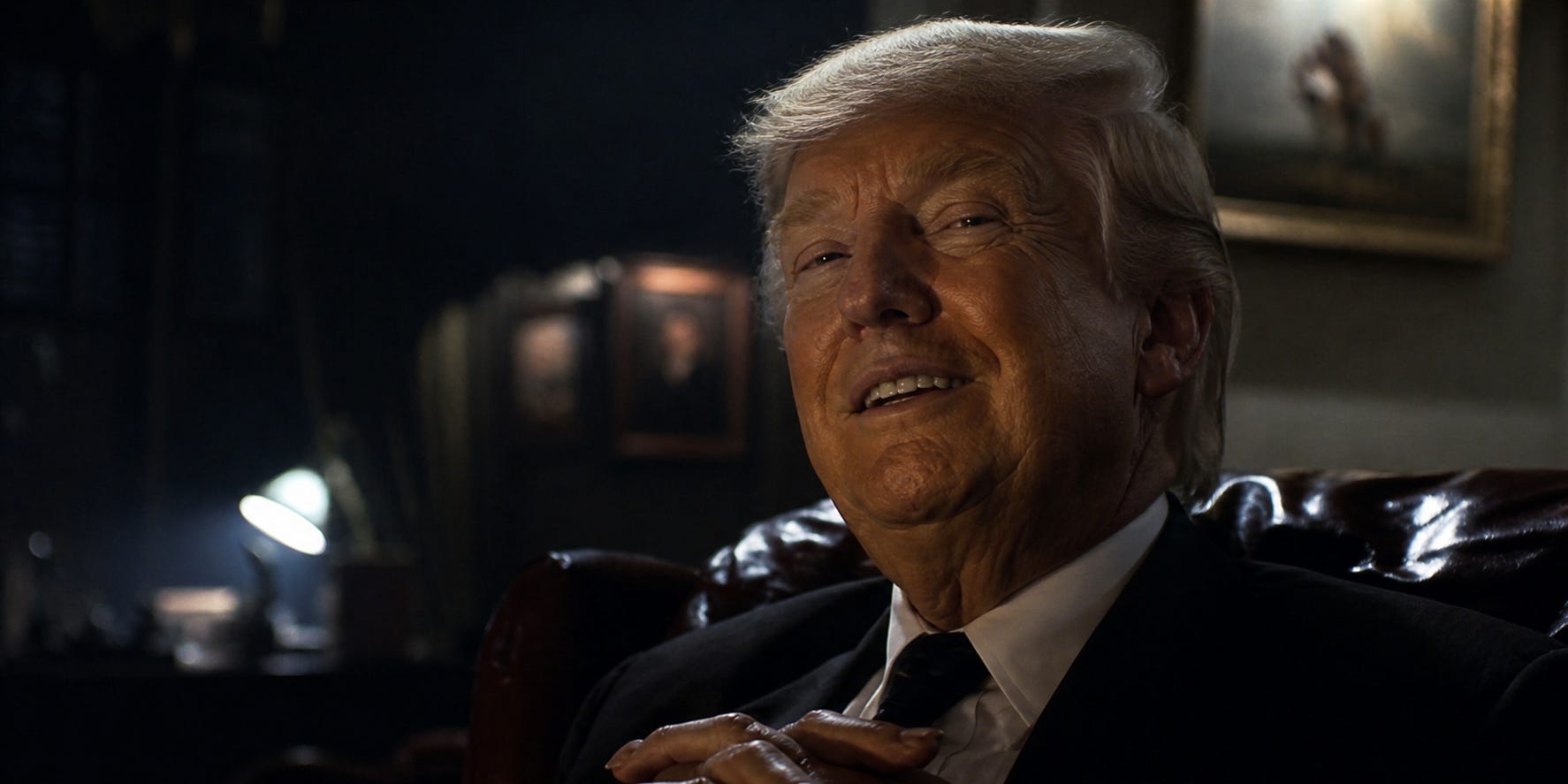
That is the United States executive branch as currently configured.
The cabinet reads like a customer list at the shop. Each appointment is a person who walked in carrying a private fixation, and each appointment received the thing on the shelf at a price they could almost believe.
Robert F. Kennedy Jr. received the Department of Health and Human Services, and the prize was the chance to act on a vaccine fixation he has carried for two decades.
Tulsi Gabbard received the Director of National Intelligence position and the prize was a long-running grievance against the intelligence community she now sits atop.
Pete Hegseth received the Department of Defense and the prize was a culture-war fixation he had spent years writing books about, now fitted with a budget.
Kash Patel received the FBI and the prize was an enemies list he had previously published in hardcover.
Stephen Miller received the deportation apparatus he had spent the entirety of the first Trump term trying to construct and could not, and now has.
Each appointee got the thing they most wanted, and each one believes the deal was for them.
The favor each cabinet member owes is the gutting of the agency they were given. Kennedy is asked to dismantle the public health architecture that vaccinates American children.
Gabbard is asked to redirect intelligence assets toward domestic political targets. Hegseth is asked to purge the officer corps of anyone who might say no.
Patel is asked to point the bureau at journalists, prosecutors, and election officials.
Miller is asked to run the deportation apparatus past the limits of what any court has previously allowed.
None of them are being asked to do the whole job, each is being asked to do their piece, and each piece looks, from inside that cabinet member’s office, like the thing they came for, with a small additional task attached.
The base got their items from the shop too.
Immigration enforcement on television, trans athletes pushed out of competitions, Department of Education layoffs, prosecutions of named cultural enemies, public humiliations of figures the base has spent a decade rehearsing hatred for.
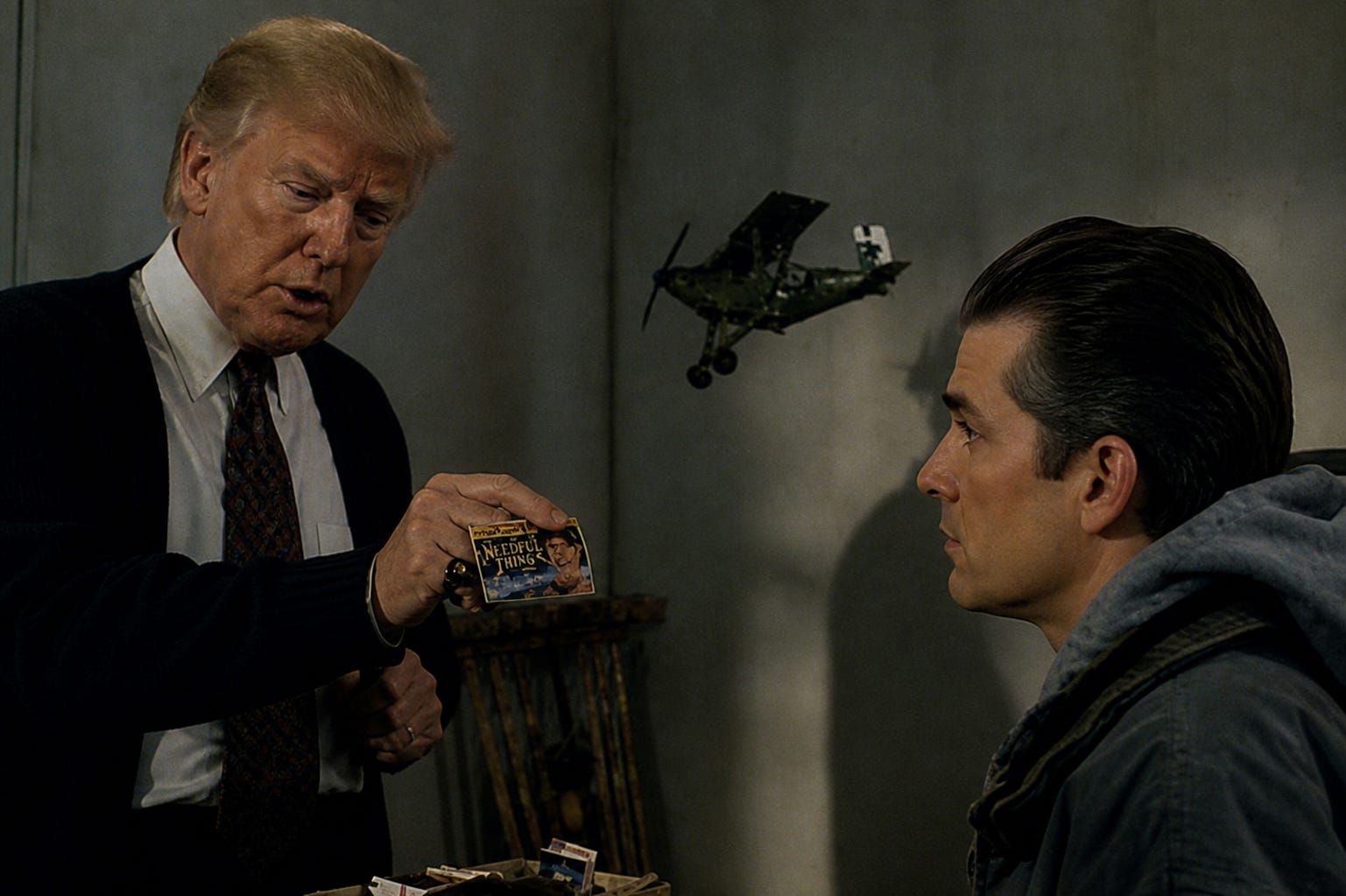
Each viewer at home received their specific prize, and each viewer is asked, in exchange, to defend a specific thing that does not survive contact with daylight, a Kushner deal with a Gulf state, a Witkoff back channel to Tehran, a tariff that empties their own grocery store, a corruption story involving a name they used to admire.
Each defense is a small favor, and each small favor inflames a relationship with a neighbor, a sibling, a coworker, a parent, until the person performing the favor cannot afford to admit they were wrong, because admitting it would mean every relationship they damaged on the way here was damaged for nothing.
The mechanism only works while each customer believes their transaction is isolated.
The Health and Human Services gutting is not connected, in any one viewer’s head, to the Food and Drug Administration gutting, which is not connected to the Department of Agriculture gutting, which is not connected to the Department of Education layoffs, which are not connected to the Department of Justice prosecutions, which are not connected to the Department of Defense purges, which are not connected to the Office of the Director of National Intelligence raid on a county elections office.
The Department of Government Efficiency assignment to review voter rolls in advance of the 2026 midterms is not connected, in the average news cycle, to the Palantir partnership with Eaton Corporation that controls power systems for roughly seventy percent of American voting equipment.
The Witkoff Iran channel is not connected, in the average news cycle, to the Trump family financial exposure in the Iran war.
The Kushner Saudi money is not connected, in the average news cycle, to the Lev Parnas testimony from the first term that already laid out, on the record, exactly how the private foreign-entangled operator mechanism works, with Parnas himself describing the function in language that maps cleanly onto Witkoff and Kushner, the same role under a different name.
Each story arrives separately, and each is reported as though it stands alone, and the customer at home sees their prize and not the bill the town is running up.
The misdirected blame is the slight of hand. In the novel, every prank is designed so the victim suspects the wrong neighbor, and the town tears itself apart on a network of grievances that have nothing to do with Gaunt.
The American version routes blame toward immigrants, trans people, Democrats, the institutional press, “globalists,” “the deep state,” and any other category broad enough to absorb whatever this week’s damage was.
The blame never lands on the cabinet, the blame never lands on the supporters, and the blame never lands on the harvesters at the top of the structure.

The architecture of the misdirection is the same architecture King described, and it is the load-bearing element, because the moment any meaningful share of the population traces the damage back to its actual source, the mechanism stops paying.
The figure behind the counter does not have to do the destroying himself, and this is the part that connects most directly to a pattern already documented in the Israeli context, where the apparatus is running whether or not Benjamin Netanyahu is present in any given week, and the war does not require him to be the one giving the daily order.
The same is true of the American executive.
The destruction of federal capacity does not require Donald Trump to deliver coherent sentences about it, the cabinet runs the agencies, the supporters defend the agencies’ destruction, and the harvesters book the profit.
Trump is the sign on the window of the shop, and the shop runs whether or not the man on the sign is awake. Gaunt in the novel is, by the final third, barely doing any work himself, because the town is doing the work for him.
The harvest is concrete and the harvesters are a small and identifiable group.
The Trump family financial exposure to the Iran war has been documented in real time.
The Kushner relationships with Saudi sovereign capital have been documented since 2018. The Witkoff function in the Tehran and Tel Aviv channels has been documented across the last twelve months.
The Tether and USDT thread, with its Lutnick adjacency and its connections to entities under sanctions, has been documented.
The defense contractor share of the current war footing has been documented.
The Future Forward donor concentration and its self-dealing consultant structure on the other side of the aisle has been documented.
The crypto regulatory pass is being booked.
The harvest is not hidden, the harvest is happening on the open shelf, while each customer at home looks at the item they were given.
The next town is already being set up.
The voter roll review assigned to the Department of Government Efficiency runs alongside the Palantir and Eaton control of voting equipment power systems, and those two together describe the physical and digital substrate of the next federal election.
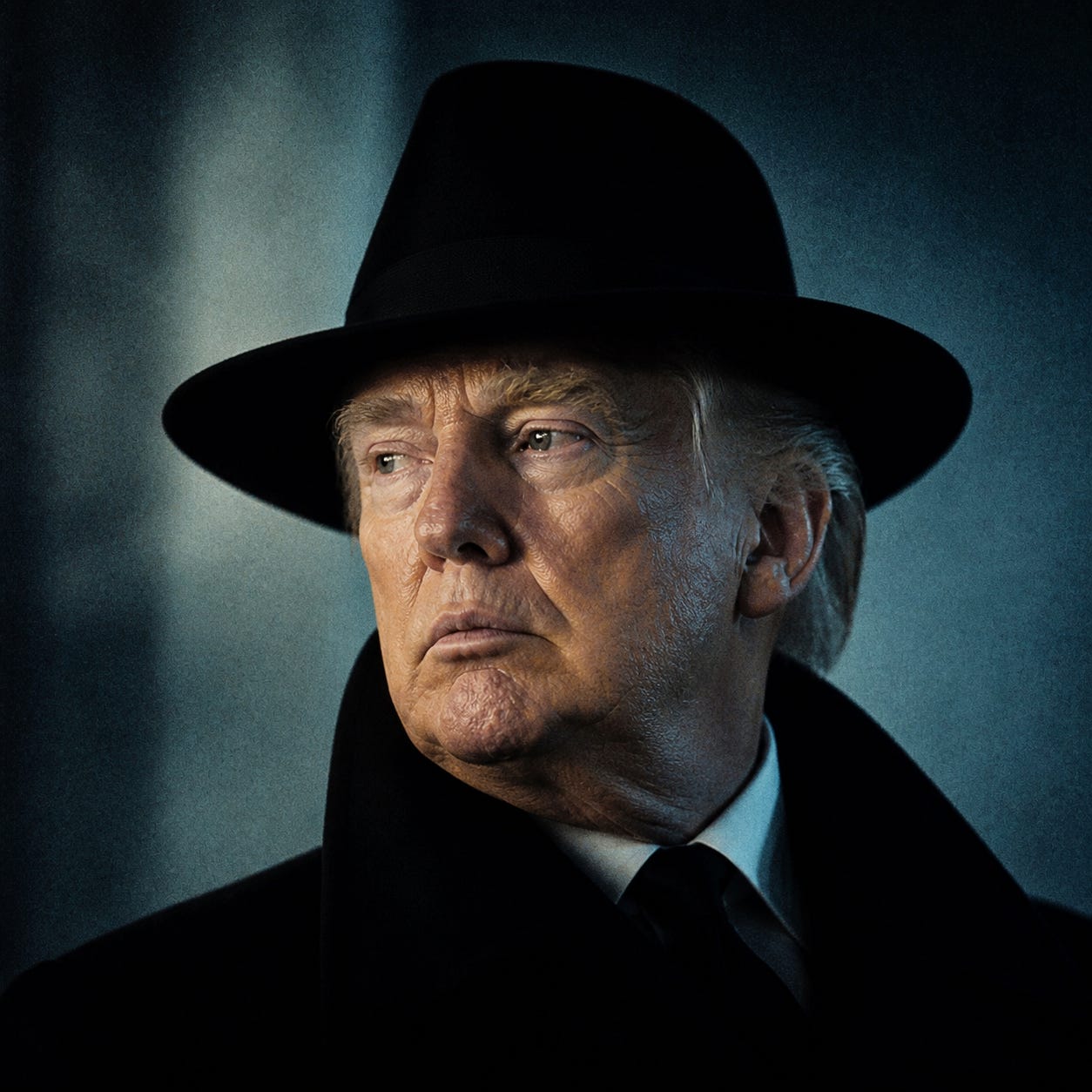
The artificial intelligence surveillance buildout is being run through agencies that no longer have inspectors general, and the unitary executive theory is being deployed in parallel to remove every remaining oversight check that might have caught it.
The legal architecture is being assembled around a 2028 transition under conditions in which the next election is run on infrastructure controlled by parties with a documented financial interest in the outcome. These are not separate stories.
They are the storefront in the next town, drafted in advance, while this town still has fires running.
What Castle Rock would have needed, in the novel, was someone who saw the mechanism and named it out loud.
King’s answer is Sheriff Alan Pangborn, who does not beat Gaunt by being stronger or louder or better armed, because Gaunt is none of those things, and being stronger does not address what Gaunt is doing.
Pangborn beats Gaunt by understanding the trick, by seeing that the pranks are connected, that the desires were the bait and not the prize, that no individual item on the shelf is worth what the item is actually paying for, and that the mechanism only functions while the customers keep their transactions in separate compartments.
The function of saying the mechanism out loud is not persuasion of the cabinet, who are bought, and not persuasion of the harvesters, who are profiting, and not persuasion of the most committed customers, who cannot afford to revisit the price.
The function of saying it out loud is to interrupt the compartments of the people who are not yet committed, who still see the items on the shelf as separate items, and who have not yet been asked for the favor that will make them defend something they cannot afford to defend.
The shop in Castle Rock burned down at the end of the novel because the town stopped buying.
There is no other ending.
The mechanism does not collapse from inside, the cabinet does not turn on itself, the harvesters do not develop a conscience, and the figure on the sign does not wake up.
The customers stop buying, or the town goes with the shop.
King wrote that ending in 1991, the book is still in print, and Castle Rock was a manual.

Another excellent piece
The strength here is in the structure, not the position. The analogy isn’t decorative, it becomes the operating system of the piece. Once introduced, everything else aligns to it without needing to be pushed.
What holds is the continuity of mechanism. Not events, not names, but the pattern that organizes them. That’s what gives it coherence beyond opinion.
The risk is density. At a certain point the accumulation starts to compress rather than expand, and the reader has to work to stay inside the thread. But the core line remains intact: not what is happening, but how it is being made to happen.
That distinction is what keeps the piece from collapsing into argument.